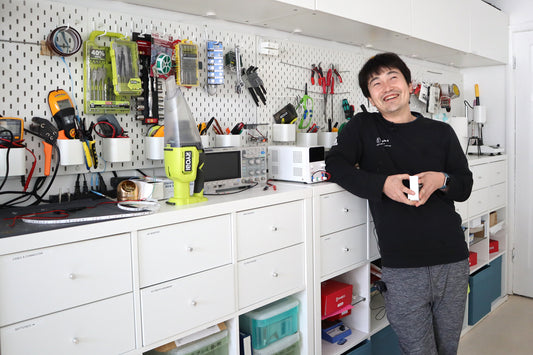
Cuzen Matcha’s product designer, Naoya Edahiro, is stacking up design awards, so we wanted to sit down with him again – this time on the Cuzen Matcha podcast, Go Greener – about the Matcha Maker Pro design that secured both the iF Design Award and the San Francisco Design Week Awards this year – each awards that Cuzen won with Naoyo for the original Matcha Maker in 2020 and 2021.
Listen in as Naoya and Cuzen Matcha founder, Eijiro Tsukada, talk about the concept behind the Matcha Maker Pro design, the story of its development, what made it stand out on the world stage and far off visions of matcha…in space.
Table of contents
- Honoring both a design and a philosophy
- A design informed by feedback and function
- Centering both convenience and care
- Award ceremonies and the beyond
1. Honoring both a design and a philosophy
Go Greener [G]: How does it feel to win these awards?
Naoya Edahiro [N]: I'm genuinely happy that the Matcha Maker Pro won an iF Design Award, following the original machine.
The iF Design Award is an international honor that any industrial designer would recognize. It's not just that I believed in the design: It means people across the industry saw the same thing. That recognition means a lot.
The San Francisco Design Week Awards reflect the city itself: strong environmental awareness, an emphasis on producing less waste, and a focus on innovation in food tech. I think the Matcha Maker Pro speaks to both.
Eijiro Tsukada [E]: For the iF Design Award, machines that pass the first round are shipped to Germany, where judges evaluate them in person, scoring criteria like function, originality and concept. It's a rigorous process.
Since the original Matcha Maker had scored well, I was honestly nervous waiting to see if the Pro would hold up. Naoya's design carried it through, and I'm proud of that.
The San Francisco Design Week Awards look beyond a product's appearance, to the philosophy behind it. Our approach has always been to create without waste, while delivering the flavor of freshly-ground matcha exactly as it should taste. Knowing that came through to the judges means a lot.
2. A design informed by feedback and function
G: What did you focus on when designing the Pro?
N: The original Matcha Maker was designed for home use, and we leaned into a distinctive, memorable look — the round window, the silver tea canister form. Details people would remember.
For the Matcha Maker Pro, built for commercial use, we took a different approach. We wanted it to feel at home in a café or cafeteria, without demanding attention. Clean and functional, but easy for a barista to work with, and something customers can watch and enjoy while their matcha is being made. The goal was to balance both of those experiences.
The design echoes traditional Japanese joinery by making the parts easily removed, cleaned and replaced. This gave it a layered, structural quality.
E: For a commercial machine that is used every day, the ease of cleaning, simplicity, and the quick resolution of problems are all enormous considerations. If a tray gets dirty, you should only need to replace the tray. If a part breaks, just that part. That's the thinking behind long-term reliability. We even went back and forth many times on things like button placement and count.
3. Centering both convenience and care
G: What was the hardest part of designing the Matcha Maker Pro?
N: We knew early on that we wanted parts that were easy to separate and remove. Turning that into something manufacturable was a real challenge for the engineering team.
A design can make sense on paper and still be difficult to produce. Looking back, finding that balance was the hardest part.
E: The biggest challenge was balancing the speed needed by a commercial machine with the quality of a slow stone grind. Grinding faster generates friction and heat, which affects the flavor. We spent a lot of time with our engineers testing where that line should sit.
We interviewed hundreds of users along the way, gathered their thoughts on improvements, and refined the design piece by piece. We also thought carefully on feedback we had collected from Matcha Maker users since the original launch. The lit-up view came from that same process — a small stage of light where customers can watch the matcha being made.
We tried a lot of new things, so even after development was mostly complete, we kept making small refinements. I'm grateful to Naoya and the whole engineering team for their work on this.
4. Award ceremonies and the beyond
G: What were the award ceremonies like?
E: At the San Francisco Design Week Awards, we served matcha drinks with the Matcha Maker Pro. We did this right alongside the ceremony after we learned there weren't many non-alcoholic drink options available.
The iF Design Award ceremony was held in Berlin, with thousands of winners from around the world in attendance. It reminded me how many strong design houses exist worldwide. It made me want to win a gold award next time.
G: Besides a gold award, what else is next for Cuzen Matcha?
N: I'd like to explore a more metal-forward commercial machine, something similar to the way an espresso machine feels solid and metal.
E: Someday, I'd like to make a matcha maker you could use in space. The "Cu" (written with the kanji “"空" means sky or open space. A tea ceremony in outer space would be a lot of fun, and it's something I feel we'll eventually need to do. For now, we're focused on bringing matcha to more places on Earth — with that dream somewhere further down the road.
- January 2020 — CES Innovation Awards Honoree"空",
- June 2020 — San Francisco Design Week Awards, Future of Foods
- August 2020 — Dezeen Awards Design Longlist
- November 2020 — Time's Best Inventions
- March 2021 — Esquire Home Design Awards
- April 2021 — iF Design Award
- October 2021 — Good Design Award
- October 2023 — Good Housekeeping Coffee and Tea Awards
- February 2024 — Cabinet Office Cool Japan Strategy, CJPF Award, Project category runner-up
- February 2026 — iF Design Award (Matcha Maker Pro)
- June 2026 — San Francisco Design Week Awards, Future of Foods (Matcha Maker Pro)
The full interview is available in Japanese on the Cuzen Matcha podcast, Go Greener, which features stories from the restaurants, bars and producers from Japan to the United States, connected through matcha. You can find episodes on Spotify and Apple Podcast.
Related products
-
Organic Matcha Leaf packets
Regular price From $25.00 AUDRegular priceUnit price / per$25.00 AUDSale price From $25.00 AUD -
Matcha Maker Starter Kit
Regular price $433.00 AUDRegular priceUnit price / perSale price $433.00 AUD -
Hojicha Starter Kit
Regular price $131.00 AUDRegular priceUnit price / perSale price $131.00 AUD -
Organic Hojicha Leaf
Regular price From $29.00 AUDRegular priceUnit price / perSale price From $29.00 AUD